

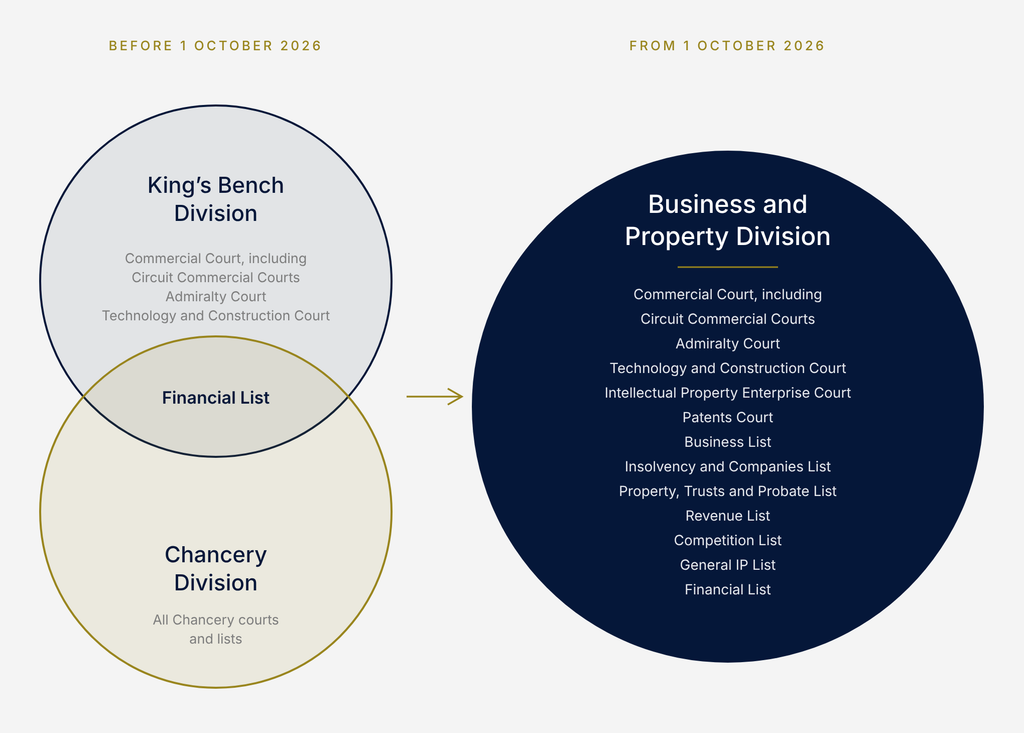
On 1 October 2026, the High Court of England and Wales underwent an administrative transformation. The Chancery Division has been renamed the Business and Property Division and expanded its jurisdiction to include additional specialist courts dealing with commercial cases. If you litigate in London, very little has changed day to day, but the reform signals that London intends to remain the go-to venue for global disputes.
The history of the Chancery Division
The Chancery Division was created by the Judicature Acts 1873 and 1875, which dissolved the Court of Chancery (the court that, over several centuries, had developed the doctrine of equity) and transferred its jurisdiction to the new division.
The Division grew steadily through the twentieth century, gaining specialist bankruptcy, companies and patents courts. In 2011, it moved into the Rolls Building, one of the world’s largest centres for business and commercial litigation.
In 2017, the “Business and Property Courts” were introduced. In practice, it was an umbrella term: some courts sat in the Chancery Division, while others (including the Commercial Court) sat in what was then the Queen’s Bench Division. Unsurprisingly, many international (and domestic) users found this confusing.
Emergence of the Business and Property Division
On 2 June 2026, the Lady Chief Justice and the Lord Chancellor announced a modernisation of the High Court’s structure by establishing a new Business and Property Division, as part of a judiciary-led reform supported by the government.
The reforms are intended to:
- Make it easier for court users to understand where to bring their cases, improving clarity and access to justice;
- Strengthen the international reputation of the Business and Property Courts by including them within a single, coherent divisional structure;
- Simplify governance arrangements for business and property work within the High Court; and
- Support flexible judicial deployment, ensuring that judges can be assigned where they are most needed.
On 15 July 2026, statutory instruments implementing those reforms, the Senior Courts (Transfer, Amendment and Consequential Provision) Order 2026 (SI 2026/723) and Civil Procedure (Amendment No. 2) Rules 2026 (SI 2026/817) were laid before Parliament. The Practice Directions were also amended (see 196th Practice Direction Update).
On 8 September 2026, Sir Colin Birss, addressed the Chancery Bar Association. He explained the reason for this change – to modernise the court structure by: “bringing together specialist courts under a coherent single Division to improve access to justice, efficiency, accessibility, and the UK’s international competitiveness”. He emphasised that it makes sense “because the work is so closely related – it is business and property work – and it is good for court users to know which Division their claims ought to be in.”
On 1 October 2026, the changes came into effect. The Chancery Division has been renamed the Business and Property Division, and the Commercial Court, the Admiralty Court, the Technology and Construction Court and the Circuit Commercial Courts have been brought into it.
On 5 October 2026, the changes to the CE-File system came into operation after being implemented over the previous weekend.
Some steps remain outstanding, such as updating the court guides, but Sir Colin Birss has hinted these will be finished soon.
Business continues
For court users, almost everything stays the same.
Several aspects of the continuity were considered and written into the rules:
- Courts and lists keep their jurisdiction, identity and specialist judges;
- Procedures and rules, including Part 58 (Commercial Court), Part 60 (Technology and Construction Court Claims), Part 63A (Financial List), still apply; and
- Case numbers remain unchanged.
If you already have a case running, you do not need to do anything: it continues as if issued in the new Business and Property Division, with no re-issuing and the same case number. The restructuring does not, of itself, affect existing orders, timetables or trial dates.
Practical changes
While the substance of the litigation is unchanged, court users should be aware of three practical changes: (i) the heading on court documents; (ii) the neutral citation of judgments, and (iii) the court guides.
New headings
Practice Note for Business and Property Division: CE-File, title of proceedings and neutral citation of judgments dated 28 September 2026 explains how titles of proceedings should be presented. These should be titled in accordance with the relevant Practice Directions, forms and court guides. In general, the format of the title is as follows:

Care should be taken when using templates. Even the courts are still adjusting to the new name. For example, Central Térmica de Temane SA v Banco Santander SA [2026] EWHC 2587 (Comm), handed down on 13 October 2026, is still headed “Business and Property Courts” rather than “Business and Property Division”, perhaps because it was initially prepared before the change took effect.
New citations
Most judgments of the Business and Property Division will now be cited “(BP)” rather than “(Ch)”.
Commercial Court (including the Circuit Commercial Courts), Technology and Construction Court, Intellectual Property Enterprise Court, Patents Court and Admiralty Court keep their own suffixes:
| Court | Format for neutral citation |
| Admiralty Court | [20XX] EWHC XXXX (Admlty) |
| Commercial Court (including Circuit Commercial Courts) | [20XX] EWHC XXXX (Comm) |
| Intellectual Property Enterprise Court | [20XX] EWHC XXXX (IPEC) |
| Patents Court | [20XX] EWHC XXXX (Pat) |
| Technology and Construction Court | [20XX] EWHC XXXX (TCC) |
| Business List Insolvency and Companies List Property, Trusts and Probate List Revenue List Competition List General IP List | [20XX] EWHC XXXX (BP) |
The Financial List is not addressed in the Practice Note. Before 1 October, Financial List judgments took the suffix of the court that heard them, (Comm) or (Ch). No Financial List judgment had been published under the new structure at the time of publication of this article.
The National Archives have a new section for the Business and Property Division judgments, while historical judgments of the Chancery Division from 2003 to 2026 remain a separate category.
Court guides
As mentioned above, the courts are working to update the court guides as soon as possible.
At the time of publication, the status of the court guides was as follows:
| Court Guide | Updated as of 16 October 2026 |
| The Commercial Court Guide (incorporating The Admiralty Court Guide) | Yes. Eleventh Edition 2022 (revised July 2023, updated October 2026) |
| The Circuit Commercial Court Guide | Not yet. 2022 edition (revised August 2023) |
| The Intellectual Property Enterprise Court Guide | Not yet. Issued in November 2024 |
| The Patents Court Guide | Not yet. Issued in June 2026 |
| The Technology and Construction Court Guide | Yes. Edition 4.1 (updated September 2026) |
| The Chancery Guide | Not yet. 2022 edition (updated September 2025) |
Until the new guides are ready, court users should continue using the current versions and treat any mention of the Chancery Division as a reference to the Business and Property Division. It is a good idea to check the judiciary website before filing, since new editions may appear with little warning. Looking ahead, Sir Colin Birss has suggested a major simplification of the guides. If this happens, it could make things easier for court users, who often have to consult several overlapping guides for one case.
Conclusion
This reform should be viewed as a positive step. It makes the courts operating in the Rolls Building easier to explain to both international and domestic clients and gives the business courts a unified presence. Whether combining judges leads to earlier trial dates – on that we will have to wait and see…
Enyo Law acts for clients in the Business and Property Division. If you are considering bringing a claim in London, we can help you decide where it belongs and what that means for timing and cost. If you already have proceedings under way, we are happy to talk through what, if anything, the reform changes for your case. Please get in touch with Lucinda Orr at Lucinda.Orr@enyolaw.com or Irina Durnova at Irina.Durnova@enyolaw.com.